
2026-09-22 · By Michael Tracy, Lightning Bay Electric · Tampa, FL
Interlock Kit vs. Transfer Switch: The Legal Way to Hook a Portable Generator to Your Tampa Home
The problem every generator owner hits in the first storm
September is the peak of hurricane season in Tampa Bay, and it is when we get the most calls that start the same way: the generator is running in the driveway, and the refrigerator, a fan and a phone charger are hanging off two extension cords through a cracked window. It works, barely, until it rains sideways, the window cannot close, and nothing hardwired in the house, not the well pump, not the garage door, not a single ceiling light or the air handler, can be powered at all.
A portable generator only becomes a real backup power system when it can feed the home's own circuits through the electrical panel. There are exactly two safe, code-legal ways to do that: a breaker interlock kit or a manual transfer switch. Both are an afternoon of work for a licensed electrician, both are permitted and inspected in every Tampa Bay county, and both end with a single inlet on the outside of the house that you plug the generator into with one heavy cord.
First, the thing you must never do: backfeeding
Before the two right answers, the wrong one. A so-called suicide cord, a cable with a male plug on both ends, plugged from the generator into a dryer or range receptacle, will indeed power the house. It will also energize the utility lines outside your house through your own meter, because nothing disconnects your panel from the grid. That backfeed travels out to the transformer, gets stepped UP to thousands of volts, and can electrocute the lineman working to restore your neighborhood. People are killed this way in almost every major storm recovery, which is why backfeeding is illegal, why it voids your homeowner's insurance, and why TECO and Duke Energy both warn about it before every storm.
It is also dangerous inside the house: the moment utility power returns while the generator is connected, the two sources collide and the generator, the panel, or both can be destroyed, sometimes with a fire. The entire purpose of an interlock or transfer switch is to make it physically impossible for the generator and the grid to be connected at the same time.
Option 1: the breaker interlock kit
An interlock kit is a sliding steel plate installed on the face of your electrical panel, engineered so that the main breaker and a dedicated generator backfeed breaker can never both be on. To use it, you shut off the main, slide the plate, and turn on the generator breaker; the panel is now fed by the generator and physically disconnected from the grid. When utility power returns, you reverse the steps.
The strengths: it is the cheapest legal connection, and it lets the generator feed any circuit in the panel, so you choose in the moment what runs, flipping breakers on and off to stay within the generator's capacity. In Tampa Bay, an interlock kit installation, including the kit matched to your specific panel brand, the backfeed breaker with its hold-down, a 30 or 50 amp inlet box mounted outside, the wiring between them, and the permit and inspection, typically runs roughly $500 to $1,200 depending on the panel and how far the inlet is from it.
The catches: the kit must be listed for your exact panel model, and some older panels, including the Federal Pacific and Zinsco panels still hiding in thousands of Tampa Bay homes built before the mid 1980s, have no listed kit at all and should be replaced anyway. Load management is on you: turn on the A/C, the water heater and the dryer at once and you will stall or trip a 7,500 watt generator.
Option 2: the manual transfer switch
A manual transfer switch is a small secondary panel mounted next to your main panel, holding six to ten of your most important circuits: refrigerator, some lights and receptacles, the well pump, the garage door, maybe a window A/C or a mini split. Each circuit has its own switch with three positions, LINE, OFF and GEN, so you move exactly those circuits to generator power one at a time, and the switch mechanism makes a grid connection physically impossible.
The strengths: it is the simplest to operate in a stressful moment, there is no full-panel shutdown, and many models include wattage meters so you can watch the load as you bring circuits on. It is also the answer when your panel has no listed interlock kit. Installed in Tampa Bay, a 6 to 10 circuit manual transfer switch with the outdoor inlet, cabling and permit typically runs roughly $900 to $2,000.
The catch: only the circuits wired into the switch can ever be powered. If the storm knocks out power for a week and you wish the ceiling fans were on the switch, that is a service call, not a flipped breaker.
Which one is right for your house?
Our honest rule of thumb after hundreds of these installs: if your panel is modern and has a listed kit, and you are comfortable flipping breakers with a flashlight, the interlock is the better value and the more flexible system. If you want the simplest possible storm-day routine, if several people in the house need to be able to operate it, or if your panel has no listed kit, the transfer switch earns its price. And if your panel is a Federal Pacific, a Zinsco, a rusted coastal panel or an overstuffed 100 amp original, the right first move is a panel replacement, which we can plan with the interlock and inlet built in from day one.
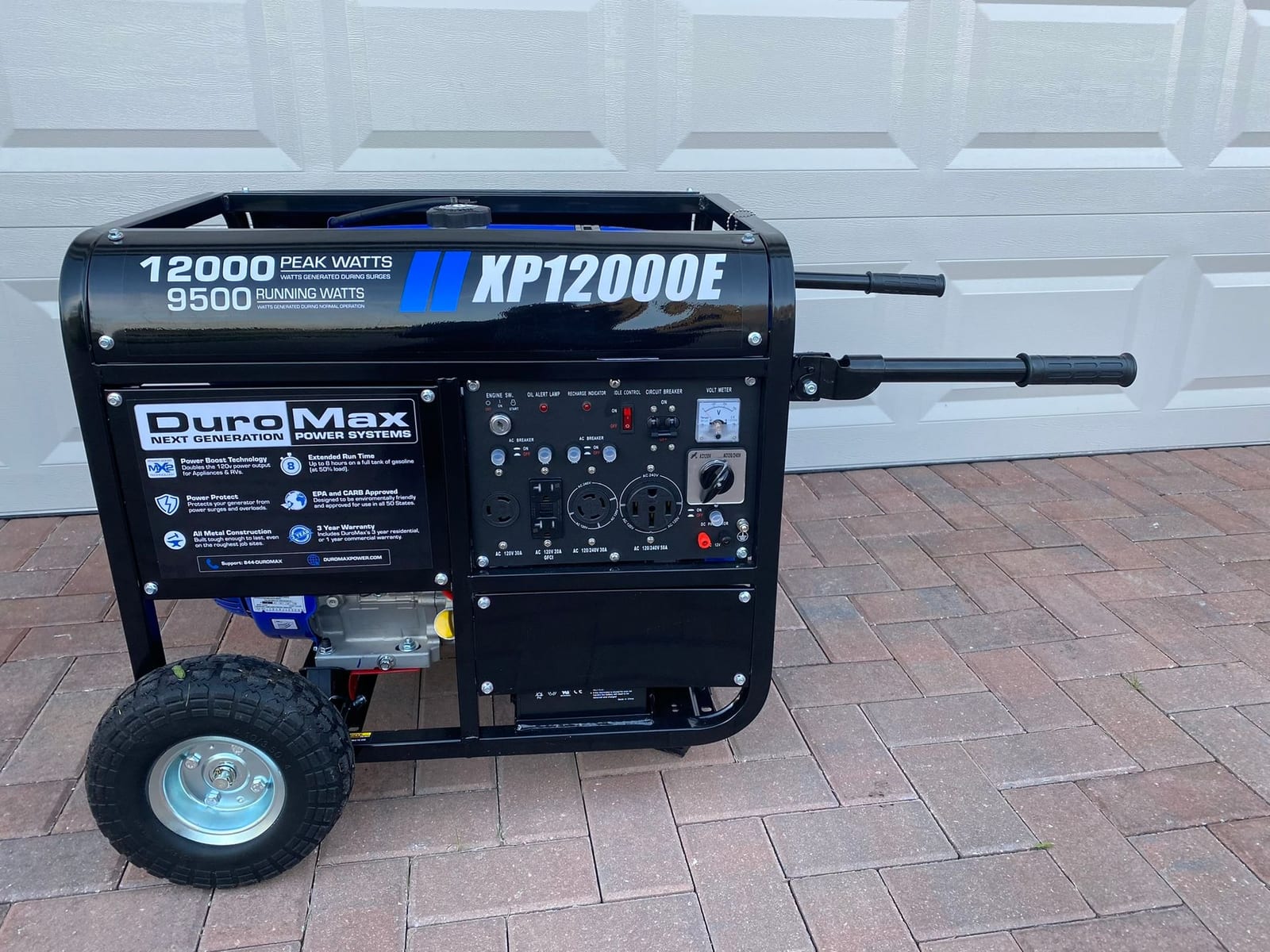
Sizing matters too. A 30 amp inlet carries up to 7,200 watts, which matches the popular 7,000 to 8,500 watt portables; a 50 amp inlet carries up to 12,000 watts for the big units like the DuroMax XP12000 and XP13000 series we deliver and install. Buying the generator and the connection as one project, sized together, avoids the classic mismatch of a 50 amp generator throttled through a 30 amp inlet. Our generator sizing guide walks through the math.
Permits, inspection and doing it in one visit
In Hillsborough, Pasco, Pinellas, Polk and Manatee counties, adding a generator inlet and an interlock or transfer switch is permitted electrical work, and the inspection protects you: it confirms the backfeed breaker is properly held down, the interlock is the listed kit for the panel, the inlet is weather-rated and grounded, and the neutral bonding is correct for your specific generator, a detail that trips GFCIs endlessly when it is wrong. Lightning Bay Electric pulls the permit, installs everything in a single visit of two to four hours, tests the full transfer with your generator running, and walks you through the storm-day steps until you are comfortable doing them yourself.
One more Florida-specific note: run the generator outdoors only, at least 20 feet from doors and windows with the exhaust pointed away from the house, never in the garage even with the door open. Carbon monoxide kills more people after Florida hurricanes than the storms themselves. A battery carbon monoxide alarm on each sleeping floor is a $25 companion to any generator plan.
Frequently asked questions
Q: Can I install an interlock kit myself? Physically, some homeowners could. Legally, in Tampa Bay counties this is permitted work on the service equipment, and an unlisted or misinstalled kit is exactly the failure that energizes the grid. This is one of the cheapest jobs an electrician does; let us take the liability.
Q: Will an interlock or transfer switch work with any portable generator? Any generator with a 30 or 50 amp 120/240 volt outlet, which includes nearly every 5,000+ watt portable. Small 2,000 watt inverter units power cords, not panels.
Q: How fast can this be installed before a storm? Outside of a hurricane watch, usually within days. Once a storm is named and inside the five-day cone, every electrician in Tampa Bay is booked and the supply houses sell out of inlets and kits. The week to install this is a calm one, not the week of the storm.
Q: Is a standby generator better? A standby generator with an automatic transfer switch is the no-effort answer and powers everything, at many times the price. Our portable vs. standby comparison covers that decision in full.
Get connected before the next cone shows up
Lightning Bay Electric installs interlock kits, manual transfer switches, generator inlets and standby systems across Hillsborough, Pasco, Pinellas, Polk and Manatee counties, permitted and inspected, and as a DuroMax authorized dealer we can deliver the generator and the connection as one project. See our generator installation page, browse the hurricane electrical prep guide, or call (813) 897-2665 for a free quote.