
2025-11-04 · By Michael Tracy, Lightning Bay Electric · Tampa, FL
Generator Sizing Guide: What Size Generator Does a Florida Home Actually Need?
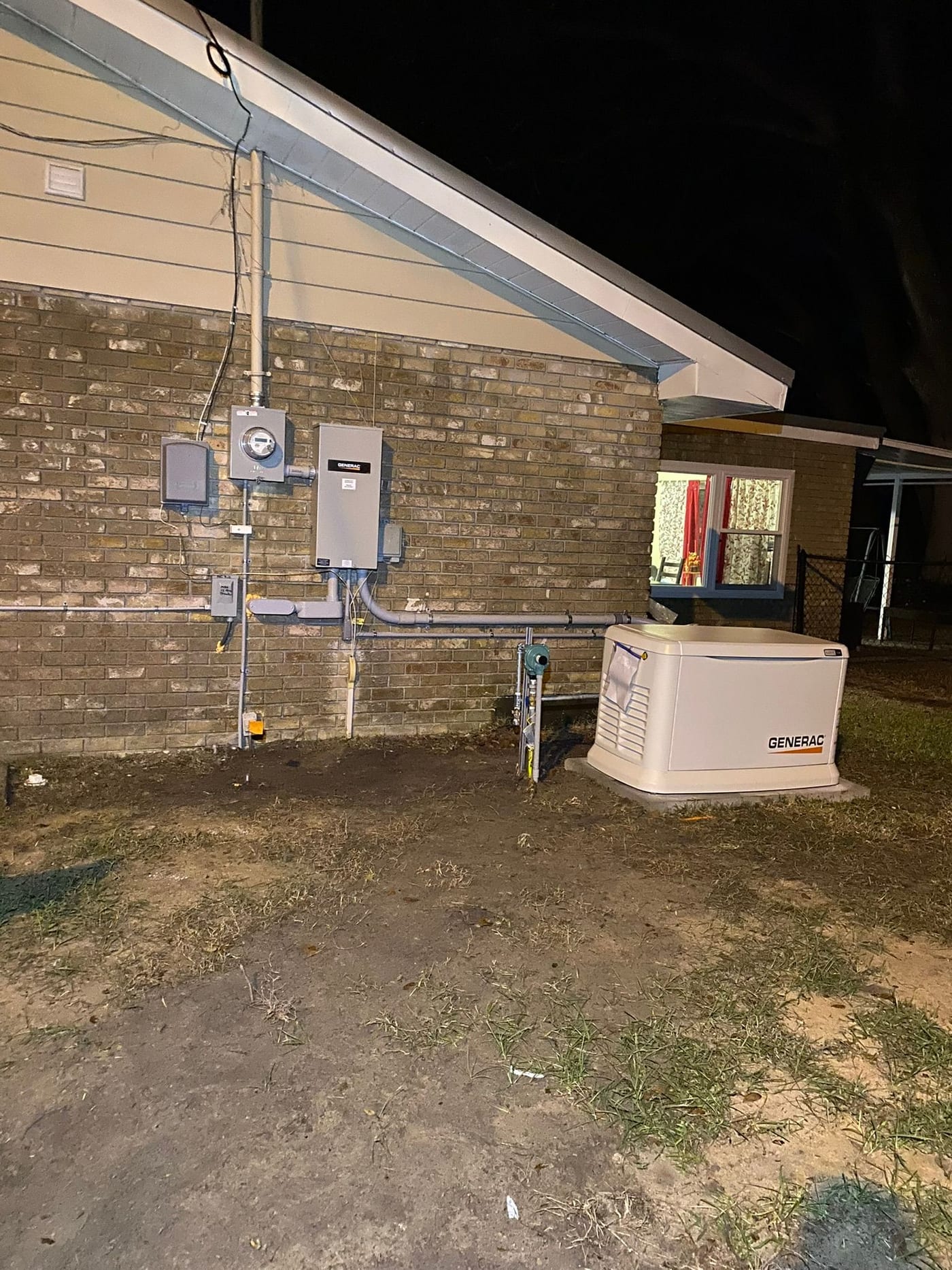
Why sizing is the most important decision
An undersized generator trips its breaker the moment the air conditioner tries to start, which in Florida means it fails at exactly the moment you need it most. An oversized generator wastes thousands of dollars up front, burns more fuel at light load, and, for standby units, can actually suffer from running too lightly loaded for long periods. Getting the size right is the whole job, and it is the part most online calculators get wrong because they ignore starting current and Florida's specific load profile.
This guide walks through the method we use on every generator quote in Tampa Bay. You can do a rough version yourself with the tables below. For a standby unit we always do a formal load calculation per NEC 2023 Article 220 and Article 702, because the transfer switch and the permit depend on it.
Running watts vs. starting watts
Every generator has two ratings. Running watts is the continuous power it can deliver. Starting watts, sometimes called surge or peak, is the short burst it can supply for a few seconds while a motor spins up. Anything with a motor or compressor, which means your AC, refrigerator, freezer, well pump, pool pump and garage door, draws several times its running current for a moment at startup.
Central air conditioning is the load that decides everything in Florida. A 3-ton AC typically draws roughly 3,000 to 4,000 running watts but may need roughly 8,000 to 12,000 starting watts depending on the compressor's locked-rotor amps. Look at the data plate on your outdoor unit for RLA (rated load amps) and LRA (locked rotor amps). Multiply LRA by 240 to get starting watts. That single number, more than anything else, tells you what size generator you need.
A soft-start kit installed on the compressor, roughly $300 to $600, can cut that starting surge by well over half. It is often the difference between needing a 22 kW standby and getting by with an 18 kW, or between a portable that can start the AC and one that cannot. We install them regularly.
Typical Florida load table
These are typical running watts we use as a starting point. Your nameplates are the real source. Central AC, 2 tons: roughly 2,500 running. 3 tons: roughly 3,500. 4 tons: roughly 4,500. 5 tons: roughly 5,500. Refrigerator: 150 to 250 running, 1,000 to 1,500 starting. Chest freezer: 100 to 200 running, 800 to 1,200 starting. Electric water heater, 4,500 watt element: 4,500 running. Electric range, one large burner: 2,000 to 2,500; full oven: 3,000 to 4,000. Electric clothes dryer: 5,000 to 5,500. Microwave: 1,000 to 1,500. Well pump, 1 hp: 1,000 to 1,500 running, 3,000 to 4,500 starting. Pool pump, 1.5 hp single-speed: 1,500 to 2,000 running, 4,000 to 6,000 starting; variable-speed pumps are far gentler. Garage door opener: 500 to 800 starting. LED lighting for a whole house: 200 to 500. Internet, TV and electronics: 300 to 600. Window AC or mini-split: 600 to 1,500.
The water heater, range and dryer are the budget-breakers. They are pure resistive loads with no surge, but they are large, and they are the loads most families can live without or rotate during an outage. That is the core trick of sizing a smaller generator: decide which big loads you will manage manually, or let a load-management module manage them for you.
Step-by-step sizing method
Step one: list every load you want running at the same time during an outage. Be honest about which ones are essential. Step two: add up the running watts of that list. Step three: identify the single largest motor load, usually the AC, and add its starting watts minus its running watts on top of the total. This assumes only one big motor starts at a time, which is how a transfer switch sequence or good habits will work. Step four: add roughly 20 percent headroom, because generators lose capacity in Florida heat and humidity, lose a little more on propane than gasoline, and you do not want to run at 100 percent.
Example: a Riverview home wants a 3-ton AC (3,500 running, 9,500 starting), refrigerator (200), freezer (150), lights and electronics (700), a well pump (1,200 running, 3,500 starting) and the microwave (1,200). Running total is roughly 6,950 watts. Add the AC surge difference of 6,000, giving 12,950 peak. Add 20 percent headroom and you land near 15,500 watts peak with roughly 8,500 running. That is a 13,000 watt class portable like the DuroMax XP13000HX with a soft-start on the AC, or a 14 to 16 kW standby with no soft-start needed. Add an electric water heater running continuously and you are squarely in 18 to 22 kW standby territory.
Whole-house vs. essential-circuits approach
There are two philosophies and both are valid. Whole-house means a standby generator and a 200-amp automatic transfer switch that backs up your entire panel. For a single-AC home that is usually a 20 to 24 kW unit. For two AC systems or a large home it is 26 kW and up, or a 22 kW with a load-shed module that prevents both compressors from starting simultaneously.
Essential circuits means a manual or automatic transfer switch that carries a selected set of circuits, typically 8 to 16: the AC, refrigerator, freezer, a few lighting and outlet circuits, the well pump, the garage door, and internet. This approach lets a much smaller and cheaper generator do the job and is the standard pairing for portables. It also works with small standby units. The tradeoff is that the circuits not on the switch simply stay dark until the utility returns.
In our experience most Tampa Bay families are happiest with whole-house standby if the budget allows, and with a 10-circuit essential-loads switch on a 10,000 to 13,000 watt dual-fuel portable if it does not. The worst outcome is a whole-house transfer switch on a generator too small to carry the house, which trips on the first AC start and leaves the family thinking the generator is broken.
Florida-specific factors that change the answer
Heat derating: generator engines lose power as air temperature rises. A unit rated at 77 degrees loses a few percent of capacity at 95 degrees, which is a normal August afternoon in Tampa. Fuel derating: propane yields roughly 10 percent less power than gasoline, and natural gas roughly 10 to 15 percent less. If you plan on propane or natural gas, size for it. Humidity and salt: coastal installs from Dunedin to Apollo Beach suffer corrosion on connections and can lose capacity over years without maintenance.
Two AC systems: very common in two-story homes in Wesley Chapel, FishHawk and Lakewood Ranch. Unless you size for both compressors starting together, you need load management, and modern transfer switches handle this well. Pool equipment: a single-speed pool pump is a big surge load. Most families simply leave the pool off during an outage, but if you want it running, include it. Medical equipment: oxygen concentrators and CPAP machines are small loads, but their importance changes the decision from portable to standby for many households.
Common sizing mistakes we fix
Buying by square footage. Square footage tells you nothing; the AC tonnage and the electric appliances do. Ignoring LRA and trusting the generator's peak rating, which is often optimistic. Connecting a whole-house transfer switch to a portable without a load plan. Forgetting the water heater is 4,500 watts all by itself. Oversizing a standby to 26 kW for a small home with gas appliances that really needs 14 kW, then wondering why the unit wet-stacks and needs more service. And the classic: sizing for today and forgetting the EV charger, the second AC or the pool heater you plan to add next year. We ask about those.
Frequently asked questions
Q: Will a 7,500 watt generator run a Florida house? It will run a refrigerator, lights, electronics and possibly a window unit, but it will generally not start a central AC of 2.5 tons or larger. For central AC, plan on 10,000 running watts or a soft-start kit.
Q: What size standby generator for a 2,500 square foot home in Tampa? Usually 18 to 22 kW for a single-AC home with electric water heating, or 14 to 18 kW if the water heater and range are gas. A two-AC home typically needs 22 to 26 kW or a load-managed 22 kW.
Q: Can I add a soft-start to my AC myself? We recommend having a licensed electrician or HVAC technician install it. It involves the compressor's high-voltage wiring and a wrong install can damage the compressor or void the warranty.
Q: Does a bigger generator use more fuel? Yes, even at light load. A 22 kW standby at 25 percent load burns noticeably more natural gas or propane than a 14 kW at 50 percent load. Right-sizing saves money every hour it runs.
Get a real load calculation, free
Send us a photo of your AC data plate and your panel and we will give you a preliminary size over the phone, then confirm it on site. Lightning Bay Electric is a DuroMax Authorized Dealer and Installer and installs Generac standby systems across Hillsborough, Pasco, Pinellas, Polk and Manatee counties. Start on our generator installation page or call (813) 897-2665 and ask for a sizing consult.