
2026-03-03 · By Michael Tracy, Lightning Bay Electric · Tampa, FL
Level 2 EV Charger Installation Cost in Tampa: Real Numbers, the 30C Tax Credit and Panel Realities
The honest 2026 range for Tampa Bay
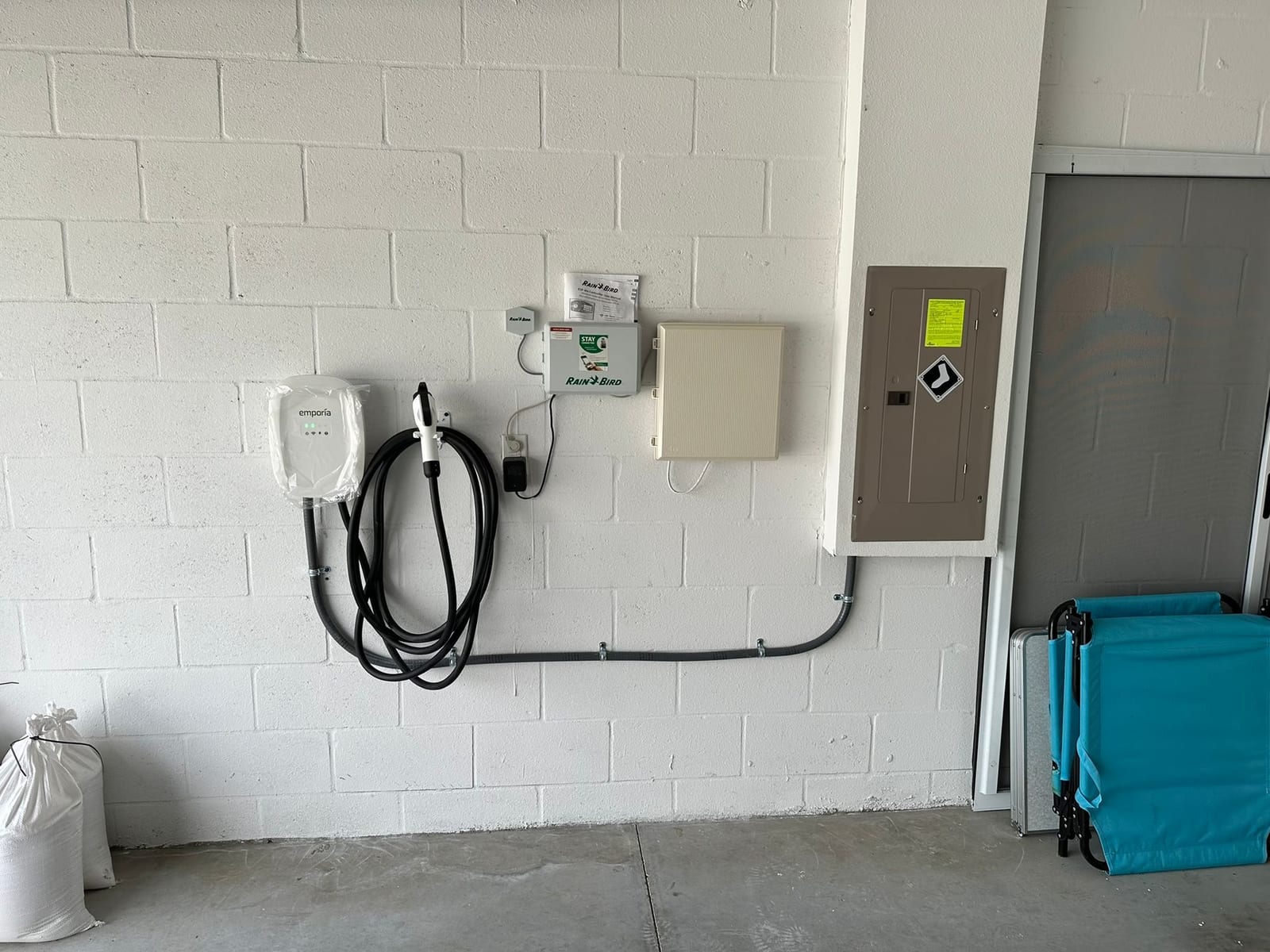
A straightforward Level 2 EV charger installation in Tampa Bay, meaning a dedicated 40 to 60 amp 240 volt circuit from a panel with available capacity to a charger location within roughly 25 feet, typically runs roughly $600 to $1,400 in labor, materials and permit, plus the cost of the charger itself, which is roughly $350 to $800 for quality units from ChargePoint, Emporia, Wallbox, Grizzl-E or the automaker's own unit. Longer runs, runs through finished walls, and detached garages typically push the installation to roughly $1,500 to $3,000. If your panel is full or your service is 100 amps, a panel upgrade adds roughly $2,000 to $7,000, and that is the number that surprises people.
So the first question on every EV charger quote is not which charger, it is what does your panel look like. Send us a photo of the open panel and a photo of the label on the panel door and we can usually tell you which bucket you are in before we come out.
Level 1 vs. Level 2, and why Level 2 is the standard
Level 1 charging is the cord that came with the car plugged into a standard 120 volt outlet. It adds roughly 3 to 5 miles of range per hour, which is enough for a plug-in hybrid or a very short commute but not for a full EV used daily. Level 2 charging runs on 240 volts, like a dryer, and adds roughly 20 to 40 miles of range per hour depending on the charger amperage and the car's onboard charger. A depleted battery fills overnight. For anyone driving a full EV in the Tampa Bay area, with its long commutes from Wesley Chapel, Riverview or Lakeland into the city, Level 2 is the practical baseline.
Most Level 2 chargers for home use are rated 32, 40 or 48 amps. A 48 amp charger needs a 60 amp circuit and must be hardwired. A 40 amp charger needs a 50 amp circuit and can be hardwired or use a NEMA 14-50 receptacle. A 32 amp charger needs a 40 amp circuit. Most cars cannot actually use more than 40 to 48 amps, and many plug-in hybrids cap at 16 to 32, so bigger is not automatically better. We match the circuit to the car and to the panel.
Hardwired vs. plug-in: which is right for you
A plug-in installation uses a NEMA 14-50 receptacle, the same outlet an RV or an electric range uses, and the charger plugs into it. Advantages: you can take the charger with you if you move, and the receptacle works for other things. Disadvantages: NEC 2023 requires GFCI protection on that receptacle, which on a 50 amp circuit means a GFCI breaker costing roughly $100 to $200 and which can nuisance-trip with some chargers; the receptacle must be a heavy-duty industrial-grade unit, not the cheap one at the hardware store, because EV charging is a continuous load that cooks bargain receptacles; and the maximum charger you can plug in is 40 amps.
A hardwired installation connects the charger directly to the circuit through a junction box. Advantages: no GFCI breaker nuisance trips because the charger has its own internal protection, no receptacle to overheat, a cleaner look, and the ability to use a 48 amp charger. Disadvantages: the charger stays with the house, and swapping it later is a small service call. For a charger that will live in one garage for years, we generally recommend hardwired. For renters or people who expect to move soon, plug-in makes sense.
The 30C federal tax credit explained plainly
The federal Alternative Fuel Vehicle Refueling Property Credit, commonly called the 30C credit, covers 30 percent of the cost of a home EV charger and its installation up to $1,000 for residential installations, when the home is in an eligible census tract. Eligibility is tied to whether your address is in a low-income community or a non-urban area as defined by the IRS, and it is not intuitive; parts of Hillsborough, Pasco and Polk counties qualify while adjacent tracts do not. The credit has been subject to legislative changes and deadlines, so you should verify the current rules and eligibility for your address with a tax professional or the IRS tool before counting on it. We will give you an itemized invoice that separates the charger, labor and materials, which is what the credit requires.
Beyond the federal credit, check with your utility. TECO and Duke Energy have each offered EV-related programs at various times, including off-peak charging rates and rebates for networked chargers enrolled in a demand response program. These programs change, so ask before you buy a charger, because the rebate sometimes requires a specific model.
Panel capacity: the question that decides everything
Adding a 48 amp continuous load to a home is a big deal electrically. NEC requires EV charging circuits to be sized at 125 percent of the charger's rating, which is why a 48 amp charger needs a 60 amp circuit. Before we install one, we run a load calculation on the panel. A 200 amp service with gas appliances almost always has room. A 200 amp service with an electric range, dryer, water heater, two AC units and a pool typically still has room but it needs to be calculated. A 150 amp service is a case-by-case decision. A 100 amp service usually does not have room for a 40 amp charger plus central AC without either a panel upgrade or load management.
Load management is the option many people do not know about. Several chargers, including Emporia and Wallbox units, can monitor your main service with current sensors and throttle the charger down when the house is using a lot of power, then ramp it back up at night. NEC 2023 recognizes this kind of energy management system, and it lets us install a Level 2 charger on a panel that would otherwise be full. The equipment adds roughly $150 to $400 and it avoids a multi-thousand dollar service upgrade in many Tampa Bay homes. A smaller charger, 24 or 32 amps, is another honest option that fills a battery overnight for most drivers.
Location, conduit and outdoor installs
Distance from the panel is the biggest labor factor. A panel in the garage with the charger on the same wall is the easy case. A panel on the opposite side of the house, with the run through a finished attic and down an exterior wall, is more. Outdoor chargers, for driveways and carports, are common in Tampa Bay and work fine, but they need a weatherproof, UL-listed outdoor-rated charger, conduit rated for sun exposure, and a mounting that keeps the connector off the ground. Detached garages need a feeder and often a subpanel, and that is a different quote.
We also plan for the second car. Many households go from one EV to two within a few years. Running the conduit and sizing the circuit so a second charger can be added, or installing a charger that supports power sharing between two units, is cheap now and expensive later.
Permits and inspection in Tampa Bay
An EV charger circuit is permitted electrical work in Hillsborough, Pinellas, Pasco, Polk and Manatee counties. The inspector checks the circuit size, the conductor size, the breaker type, the GFCI requirement for receptacles, the disconnect requirements for hardwired units over 60 amps, and the mounting height. We pull the permit, which typically adds roughly $100 to $250, and we meet the inspector. A permitted install matters for insurance, for your automaker's warranty on the charger, and for resale, where a permitted EV circuit is now a listed feature that buyers look for.
Frequently asked questions
Q: Can I just plug my EV into my dryer outlet? You can physically, with an adapter, but you should not. Dryer circuits are not sized for continuous loads, the receptacle is not rated for it, and sharing a circuit means you cannot run the dryer at the same time. We have replaced melted dryer receptacles from exactly this practice.
Q: How long does an EV charger install take? Two to four hours for a straightforward garage install. Most of a day for long runs or outdoor installs. Panel upgrades add a day.
Q: Which charger brand do you recommend? ChargePoint, Emporia, Wallbox and Grizzl-E are the ones we install most and all are solid. The automaker units from Tesla, Ford and others are also fine. The main things are UL listing, a cable long enough to reach the port, and whether you want Wi-Fi scheduling for off-peak rates.
Q: Will charging an EV at home raise my electric bill a lot? Typically by roughly $40 to $80 a month for average driving at TECO or Duke residential rates, much less than the gasoline it replaces. Off-peak scheduling lowers it further.
Q: Do I need a 60 amp circuit? Only if your car accepts 48 amps and you want the fastest home charging. Most drivers are perfectly served by a 40 amp charger on a 50 amp circuit, and many by 32 amps.
Ready to charge at home?
Lightning Bay Electric installs Level 2 EV chargers across Tampa, Brandon, Riverview, Wesley Chapel, St. Petersburg, Clearwater, Lakeland and Bradenton. We will check your panel, recommend the right circuit and charger, handle the permit and give you the itemized invoice you need for the 30C credit and utility rebates. See our EV charger installation page or call (813) 897-2665 for a free quote.