
2025-10-07 · By Michael Tracy, Lightning Bay Electric · Tampa, FL
DuroMax vs. Generac, Portable vs. Standby: Which Generator Fits a Tampa Bay Home?
Why we can compare these honestly
Lightning Bay Electric is a DuroMax Authorized Dealer and Installer, and we also install Generac standby generators and their transfer switches every month. We are not a one-brand shop, and we are not the kind of company that sells whatever has the highest margin that quarter. The right answer depends on your house, your budget, and how hands-on you are willing to be during a storm. This article lays out the differences the way I would explain them at your kitchen table.
One clarification first, because the brand names get mixed up with the product types. Generac makes both portable and standby generators, but in Florida the name is almost synonymous with air-cooled standby units. DuroMax is best known for heavy-duty portable and dual-fuel portable generators, and the company has expanded into larger inverter and tri-fuel units. So most of the real decision is portable vs. standby, with the brand question sitting inside each category.
Portable vs. standby: the fundamental difference
A standby generator is a permanent appliance. It sits on a pad outside, connects to your natural gas or propane supply, and is wired through an automatic transfer switch. When TECO or Duke drops, it senses the loss, starts, and transfers your home in roughly 10 to 30 seconds. When the utility returns, it transfers back and shuts down. You never touch it. That convenience is what you pay for, typically roughly $10,000 to $20,000 installed for an air-cooled unit.
A portable generator is an engine on wheels. You roll it out of the garage to a safe outdoor location at least 20 feet from the house, fill it with gasoline or connect a propane cylinder, pull-start or push-button start it, and plug a heavy cord into an inlet box that feeds a manual transfer switch or interlock we install on your panel. You manage fuel every 8 to 12 hours. A quality dual-fuel portable in the 9,000 to 13,000 watt class runs roughly $1,200 to $3,500, and the inlet and transfer switch install typically adds roughly $800 to $1,800.
Neither is better in the abstract. A standby is better if you want zero effort, if anyone in the home depends on medical equipment, if you travel during hurricane season, or if you simply value not babysitting an engine. A portable is better if budget is the constraint, if you are comfortable handling fuel, or if you rent and cannot install a permanent unit.
DuroMax: what we like and what to know
DuroMax built its reputation on dual-fuel portables, meaning the same unit runs on gasoline or propane, and it is the reason we became a dealer. In a hurricane, gasoline is the first thing to vanish from Tampa Bay stations, and it goes stale in a few months. Propane stores indefinitely, is easy to stockpile in 20 and 40 pound cylinders, and burns cleaner. Being able to switch fuels mid-outage is a real advantage.
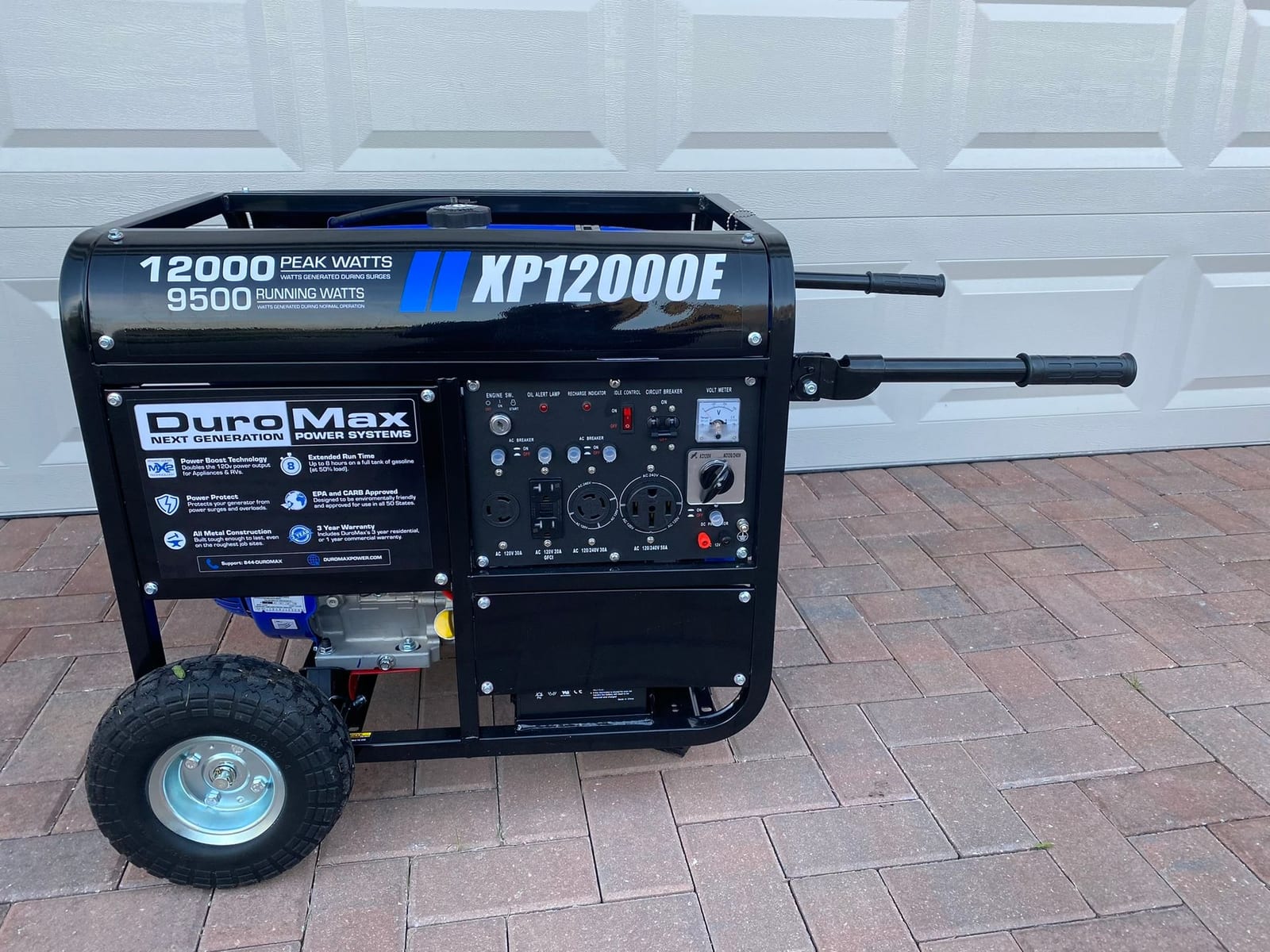
The XP12000E and XP13000HX are the units we deliver most often to Riverview, Brandon and Valrico homes. They push roughly 9,500 to 10,500 running watts on gasoline, a little less on propane, which is enough to run a central AC up to about 3 tons plus a refrigerator, well pump, lights and electronics when wired through a properly sized transfer switch. The engines are large, the frames are heavy steel, and the 50-amp outlet is what makes whole-panel backup practical. Their newer tri-fuel models add a natural gas connection, which is a great option if you have gas at the house and want portable pricing with utility fuel.
Honest drawbacks: these are loud open-frame units, roughly 72 to 76 decibels at 23 feet, which is the nature of conventional portables. They are heavy, north of 200 pounds, so plan where it lives. And like every portable, they need you present to start and refuel. As a dealer, we deliver, set up, do the first start with you, and install the inlet and transfer switch so the whole system is ready before a storm.
Generac: what we like and what to know
Generac air-cooled standby units, the 14, 18, 22 and 26 kW Guardian series, are the most widely installed home standby generators in Florida, and that matters for parts and service. Every generator company in Tampa Bay knows them, the transfer switches are proven, and the mobile-link monitoring lets you see status from your phone. When we install a Generac standby, we are installing a known quantity that inspectors in Hillsborough, Pasco and Pinellas have seen a thousand times.
Honest drawbacks: the units are not cheap, installed prices climbed a lot between 2020 and 2024 and only partially came down, and demand spikes after every storm can push equipment lead times out by months. Generac's own portable lineup is fine but is not the reason to buy the brand. And air-cooled units in salt air, which is most of Pinellas and the coastal stretch from Apollo Beach down to Bradenton, need enclosure and connection inspections every year or corrosion gets ahead of you. We address that in our maintenance visits.
Side by side for a typical Tampa Bay home
Picture a 2,200 square foot block home in Brandon with one 3.5-ton AC, electric water heater, electric range and a pool pump. Option one: a DuroMax XP13000HX with a 50-amp inlet and a 10-circuit manual transfer switch. Installed cost typically roughly $3,000 to $5,000 total including the generator. During an outage you run the AC, refrigerator, lights, internet and some outlets, but you manage the water heater and range by turning them on only when the AC is off. You refuel roughly twice a day.
Option two: a 22 kW Generac standby with a 200-amp automatic transfer switch on natural gas. Installed typically roughly $13,000 to $18,000. During an outage everything runs, the generator starts itself, and you may not notice the power went out except for the engine sound. The difference in price is roughly $10,000 to $13,000, which over a 15 to 20 year generator life is the cost of never having to think about it.
Both are legitimate. I have both types at family members' homes. The mistake is not choosing either; it is choosing neither and then trying to buy one the day after landfall.
The install details that matter more than the brand
Whichever you choose, the installation determines safety. For a portable, that means a properly rated inlet box outdoors, a listed transfer switch or interlock kit on the panel so the generator can never backfeed the utility lines, correctly sized conductors, and a bonding arrangement that matches whether the generator has a bonded or floating neutral. It also means the carbon monoxide rule that has no exceptions: a portable never runs in a garage, under a carport, on a lanai, or near a window, even with the door open. CO deaths after hurricanes are almost entirely from generators placed too close to the house.
For a standby, it means a permitted install with the transfer switch sized to your service, a gas line sized for full-load BTU demand, proper clearances, and commissioning under real load. The brand on the cover matters less than whether those things were done right. Unpermitted generator installs are one of the most common things we are hired to fix, and fixing is usually more expensive than doing it right the first time.
Frequently asked questions
Q: Is DuroMax a good brand compared to Generac? For portable dual-fuel generators, yes, DuroMax is among the best values in the class and the reason we carry them. For permanent standby units, Generac has the deeper installed base and service network in Florida. Comparing a DuroMax portable to a Generac standby is really comparing product types, not brand quality.
Q: Can a portable generator run my central AC? Usually, if it is a 9,000-watt-plus unit and your AC is 3.5 tons or smaller. AC compressors draw a large starting current for a moment, so the generator's surge rating matters. A soft-start kit on the AC, roughly $300 to $600 installed, makes it much easier on a portable.
Q: How much propane does a portable burn? A 10,000 watt unit at half load typically burns roughly one 20-pound cylinder every 5 to 8 hours. Plan on three to four cylinders per day of real use and keep a week's worth if you can.
Q: Do I need a permit for a portable generator? Not for the generator itself, but the inlet and transfer switch are permanent electrical work and require an electrical permit in every Tampa Bay county. We pull it.
Q: What is a transfer switch and why is it required? It is the device that disconnects your home from the utility before connecting the generator, so power can never flow backward into the lines where linemen are working. It is required by code and by basic decency.
Let us spec both options for your house
Whether you want a DuroMax portable delivered and wired in before June or a Generac standby that runs itself, Lightning Bay Electric will quote both so you can decide with real numbers. We are family-owned, licensed (FL EC13013571), BBB accredited, and we serve Tampa, Brandon, Riverview, Apollo Beach, Wesley Chapel, Lakeland, St. Petersburg, Clearwater and the surrounding counties. Visit our generator installation page or call (813) 897-2665 for a free on-site estimate.