
2025-09-16 · By Michael Tracy, Lightning Bay Electric · Tampa, FL
Is a Whole-Home Generator Worth It in Florida? A Master Electrician's Honest Math
The short answer
For most Tampa Bay homeowners who plan to stay in their house for five or more years, a whole-home standby generator is worth it, but not for the reason the sales brochures push. It is not really about comfort. It is about the three things a multi-day outage in August actually threatens: your air conditioning in 95-degree humidity, several hundred dollars of food in the refrigerator and freezer, and, for a growing number of families, medical equipment or a home office that cannot go dark for a week. If none of those apply to you, a good portable generator with a proper transfer switch may be the smarter spend. We install both, so we have no reason to steer you one way or the other.
I have been in the electrical trade for nearly 20 years, most of it here in Hillsborough County, and the conversation after every major storm is the same. The people who had a generator are glad they did. The people who did not are calling us while the power is still out, when lead times are longest and prices are highest. The goal of this article is to let you make the decision calmly, in the off-season, with real numbers.
What Tampa Bay outages actually look like
Florida is the lightning capital of the United States, and the Tampa Bay area sits right in the heaviest strike corridor. That means short outages of a few minutes to a few hours happen many times a year during summer thunderstorm season, from roughly June through September. Those short outages are an annoyance, not a crisis, and a surge protector matters more than a generator for them.
The outages that justify a standby generator are the long ones. After Hurricane Irma in 2017, and again after Ian in 2022 and the 2024 storms, many TECO and Duke Energy customers in Hillsborough, Pasco, Pinellas and Polk counties were without power for several days, and some neighborhoods went more than a week. Restoration typically happens in order of priority: hospitals and critical infrastructure first, then the feeders that restore the most customers per repair, then the individual laterals and neighborhoods at the end of the line. If your home is on a long rural feeder in Lithia, Wimauma, Odessa or Land O' Lakes, you are statistically going to wait longer than someone in a dense part of South Tampa.
So the honest framing is this: you are not buying a generator for the 30 short outages a year. You are buying it for the one multi-day outage every few years, and you are buying it before that outage, because nobody can install one during it.
What a whole-home standby generator costs in 2026
Here are the ranges we actually see on Tampa Bay jobs, all-in with permit, installation and the automatic transfer switch. A 14 to 18 kW air-cooled unit that carries a typical 1,800 to 2,500 square foot home including one central AC typically lands between roughly $10,000 and $15,000 installed. A 22 to 26 kW air-cooled unit for a larger home or a home with two AC systems usually runs roughly $14,000 to $20,000. Liquid-cooled units in the 30 to 48 kW range for large estates or homes with heavy loads are generally $25,000 and up.
What moves the number inside those ranges: the fuel source (natural gas from TECO Peoples Gas is the simplest if it is at the street; propane requires a buried or above-ground tank, which adds roughly $1,500 to $4,000 depending on size and whether you lease or buy it), the distance from the generator pad to your electrical panel and gas meter, whether your existing panel is in good enough shape to accept the transfer switch or needs an upgrade, and site work like a poured pad and code-required clearances from windows and doors. We give line-item quotes so you can see exactly where the money goes.
Both brands we install are in this mix. We are a DuroMax Authorized Dealer and Installer, and we also install Generac standby units, which remain the most common standby brand in Florida. If you want a brand comparison, read our post on DuroMax vs. Generac, portable vs. standby.
The cost of not having one
This is where people under-count. A single multi-day outage in summer can mean roughly $300 to $600 of spoiled food for a family, a hotel stay if anyone in the house cannot tolerate the heat, lost income if you work from home, and, in humid Florida, mold growth inside a sealed house that sits at 85 degrees and 80 percent humidity for four days. Mold remediation after a long outage is a real insurance claim category here, and it is not a cheap one.
Add the less obvious items: a sump or well pump that stops, a garage door that will not open, a freezer full of fish from a Boca Ciega Bay trip, security cameras offline, and a refrigerator compressor that fails from the repeated surges as the grid comes back. None of these alone justify a generator. Together, over a decade of ownership, they usually do.
Resale value and insurance
A permitted, professionally installed standby generator is one of the few home improvements in Florida that buyers consistently pay for. Real estate agents in Tampa Bay tell us it is a listed feature that shortens time on market, and appraisers will generally give credit for a fixed, permanent unit with an automatic transfer switch in a way they will not for a portable generator sitting in the garage. You should not expect dollar-for-dollar recovery, but a meaningful share of the cost typically comes back at sale.
Some insurers offer modest discounts for a standby generator, mostly because it reduces mold and water-damage claims. Ask your agent. Also ask what they require: a permitted install with a listed transfer switch is the standard, and an unpermitted install can create problems at claim time and on your next 4-point inspection.
Standby vs. portable: the honest comparison
A standby generator is permanently installed, runs on natural gas or propane, starts itself within seconds when the utility drops, and exercises itself weekly. You do nothing. A portable generator costs a fraction of the price, roughly $1,200 to $3,500 for a quality dual-fuel unit in the 9,000 to 13,000 watt range like the DuroMax XP12000E or XP13000HX, but it requires you to wheel it out, fuel it, start it, and plug it into a manual transfer switch or interlock kit that we install for roughly $800 to $1,800.
If you are physically able and willing to manage a portable during a storm, and you want to spend a few thousand rather than a few tens of thousands, a portable with a proper transfer switch is an excellent choice, and we say that as a company that sells both. The one thing we will not do is install a transfer-switch-free setup. Backfeeding through a dryer outlet is illegal, it can electrocute a lineman, and it can burn your house down. We explain the sizing difference in our generator sizing guide.
What a proper installation includes
A standby generator is a permitted electrical and gas job in every Tampa Bay county. In Hillsborough County, that means an electrical permit, a gas permit if we are running gas, an inspection of the transfer switch and grounding, and an inspection of the gas line and pressure. Pinellas, Pasco, Polk and Manatee are similar. We pull the permits under our license, FL EC13013571, and we meet the inspector.
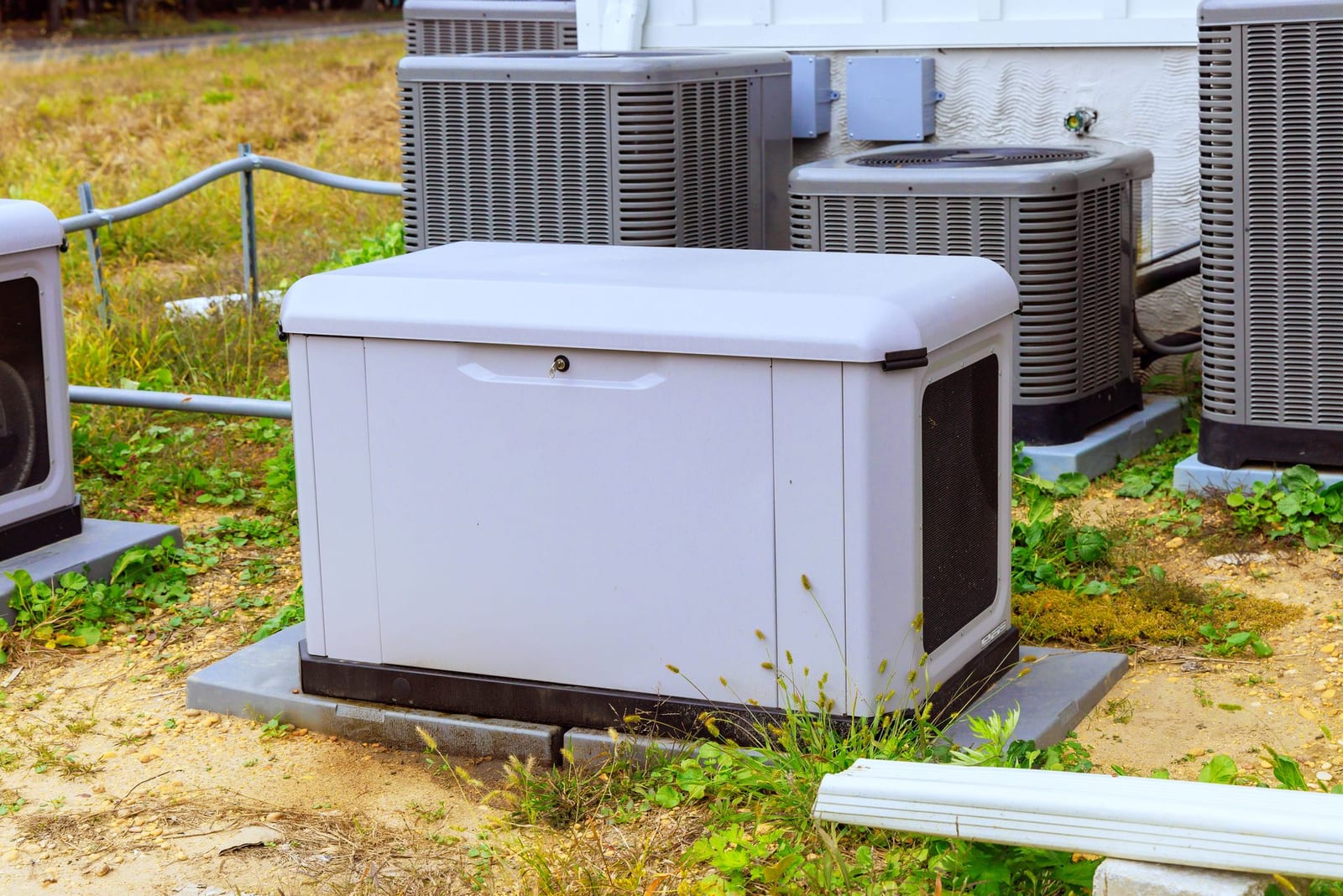
The installation itself covers a level, code-compliant pad; the generator set with the manufacturer-required clearances from openings, including the carbon monoxide setbacks we take seriously; the automatic transfer switch, which is the brain of the system and must be a listed unit sized to your service; a dedicated gas line sized for the generator's BTU demand at full load, which is often larger than people expect; bonding and grounding per NEC 2023; and commissioning, where we run the unit under load, verify transfer timing, and walk you through the controller. Most single-day installs take a full day, with the gas work sometimes a second day.
Frequently asked questions
Q: How long does a standby generator take to install in Tampa Bay? Typically one to two days on site once equipment is in hand. Equipment lead times vary from a couple of weeks in the off-season to a couple of months after a named storm, which is why we strongly recommend ordering in winter or spring.
Q: Can a generator run my whole house including the AC? Yes, if it is sized for it. Central AC is the single largest load in a Florida home and the compressor's starting current is the limiting factor. A 22 kW unit handles most single-AC homes with everything else running. A load-management module can let a smaller generator stage two AC units so they never start at the same time.
Q: Do I need to do anything to maintain it? An annual service, which is an oil and filter change, a battery check, and a load test, typically runs roughly $250 to $450. The unit exercises itself weekly. We check salt-air corrosion on coastal installs in Apollo Beach, St. Pete and Dunedin, where enclosures and connections suffer faster.
Q: Is natural gas or propane better in Florida? Natural gas if it is available at your street, because you never refuel. Gas service very rarely goes out during hurricanes because it is underground. Propane is the answer where there is no gas main, and a 250 to 500 gallon tank typically carries a mid-size generator for several days to a week of continuous use.
Q: What about a battery backup instead? Batteries are excellent for short outages and for pairing with solar, but a battery that can run a central AC for three days costs far more than a generator. Many of our customers end up with both: a small battery for instant, silent coverage and a generator for the long haul.
Ready to see real numbers for your house?
We will come out, look at your panel, your gas meter and your yard, and give you a line-item quote for both a standby and a portable-with-transfer-switch option so you can compare honestly. Lightning Bay Electric is a family-owned, licensed and insured Florida electrical contractor, BBB accredited, serving Tampa, Brandon, Riverview, Apollo Beach, Wesley Chapel, St. Petersburg, Clearwater and the rest of Tampa Bay. Learn more on our generator installation page or call (813) 897-2665 to schedule a free estimate before the next storm season, not during it.