2026-06-16 · By Michael Tracy, Lightning Bay Electric · Tampa, FL
Commercial Electrical Emergencies: A 24/7 Guide for Tampa Bay Business Owners and Property Managers
What counts as an emergency
Not every electrical problem at a business is an emergency, and knowing the difference saves money. An emergency is anything that threatens life, threatens the building, or stops revenue in a way that cannot wait until morning: a burning smell or visible smoke from a panel, a disconnect or transformer; a partial power loss where some equipment runs and some does not, which on three-phase service usually means a lost phase and can destroy motors within minutes; a total power loss where TECO or Duke confirms their service is fine; water intrusion into electrical equipment; a walk-in cooler or freezer down at a restaurant or grocery; an elevator, fire alarm or emergency lighting failure; or an exposed live conductor where the public can reach it.
A single dead outlet, a flickering light, a tripped breaker that resets and holds, or a parking lot light out are service calls, not emergencies, and scheduling them for regular hours is cheaper. We will tell you honestly which one you have when you call.
The first five minutes
If there is smoke, fire, or a burning smell you cannot immediately trace to an appliance, get people out and call 911 first, then us. If it is safe, shut off the main disconnect. If there is water near electrical equipment, do not walk through it; shut power off from a dry location or wait for the utility or us. If the whole building is dark, check the utility's outage map for TECO or Duke Energy before calling an electrician, because a neighborhood outage is their problem and they will not let us touch their side. If the neighbors have power and you do not, or if you have partial power, call us.
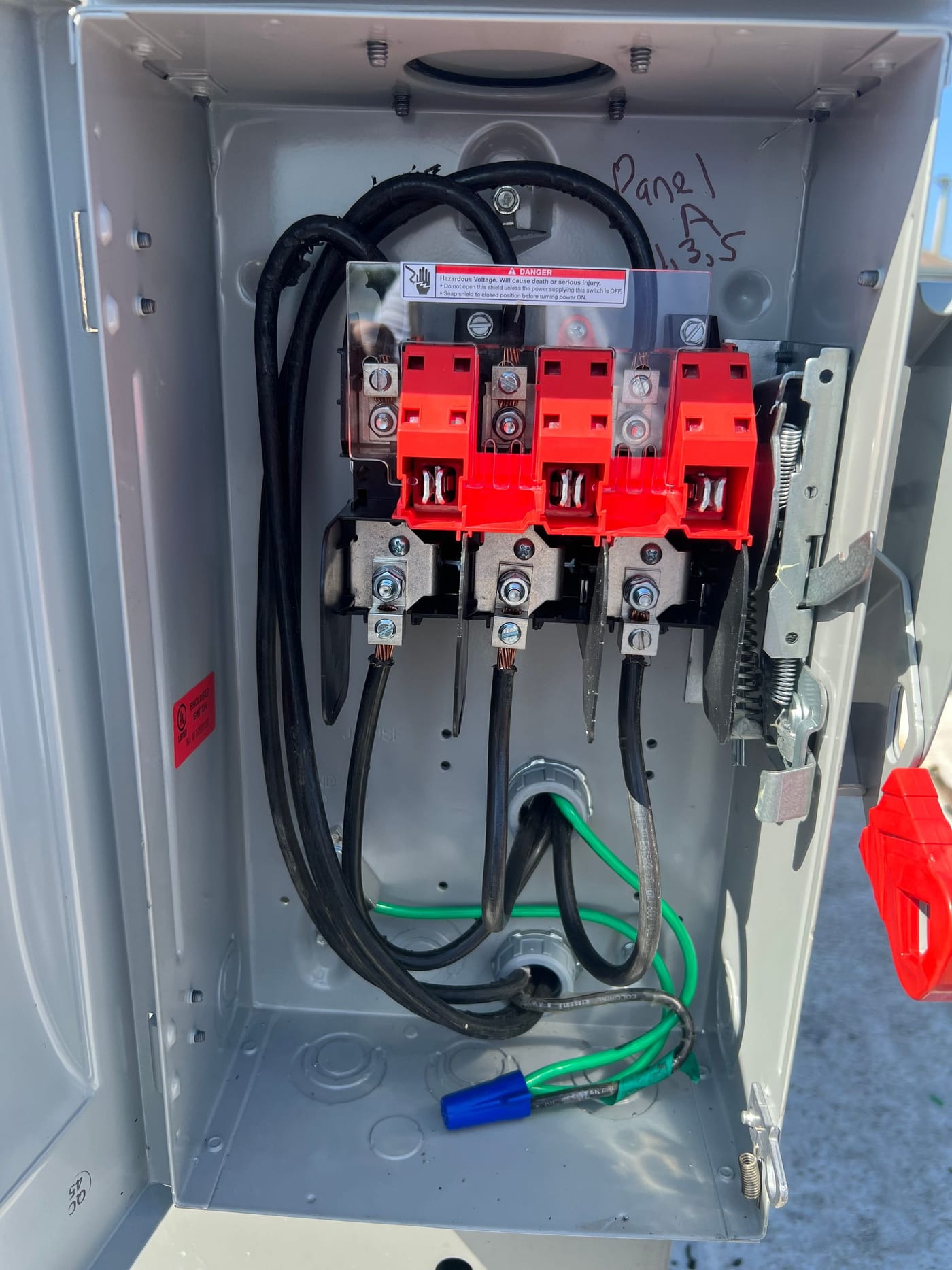
For a lost phase on three-phase service, which shows up as some lights dim, some equipment humming but not running, and motors that will not start or run rough, shut down every motor you can immediately: HVAC rooftop units, compressors, pumps, conveyors, and walk-in condensers. Single-phasing burns out three-phase motors fast, and a rooftop unit compressor is far more expensive than an hour of downtime. Then call. Lost phases are sometimes the utility and sometimes a blown fuse in your main disconnect, and we find out quickly.
The commercial emergencies we see most in Tampa Bay
Blown fuses in a main or branch fused disconnect are the single most common three-phase call, usually from a motor that has begun to fail, a lightning-induced surge, or decades of heat cycling in an unconditioned electrical room. Failed contactors and starters on HVAC and refrigeration equipment are next. Burnt lugs and bus connections in older panels, especially in coastal buildings in St. Petersburg, Clearwater, Apollo Beach and Ruskin where salt air attacks aluminum connections, show up as heat, discoloration and eventually arcing. Flooded or rain-soaked exterior equipment after a storm is a summer staple. Failed emergency lighting and exit signs are found during fire marshal inspections and become urgent immediately. And lightning damage to control systems, lighting controls, sign circuits and parking lot lighting after a summer storm fills our schedule every July and August.
Restaurants and food service have their own pattern: a walk-in or reach-in down is a product loss measured in thousands of dollars per hour of delay, and a hood exhaust fan failure closes the kitchen. We prioritize those. Medical offices, dental practices and veterinary clinics with failed X-ray or sterilization circuits are similar. Multi-tenant retail and office buildings usually call us through the property manager, and the question is often which tenant's equipment is the cause.
What a commercial emergency call costs
Our 24-hour emergency rate for commercial work in Tampa Bay is higher than the regular-hours rate, which is true of every contractor, and we tell you the rate before we dispatch. A typical after-hours diagnostic and minor repair, such as replacing blown fuses, resetting and testing a disconnect, or replacing a failed contactor, commonly runs roughly $350 to $900 including the trip. A burnt lug or bus repair in a panel, which often requires a temporary fix that night and a permanent repair in daylight, commonly runs roughly $800 to $2,500. A failed main disconnect or a damaged service typically runs into the thousands and involves the utility. We carry common three-phase fuses, contactors, breakers and disconnect parts on the truck so most calls are fixed on the first visit.
Where the cost gets out of hand is when a minor problem is ignored until it becomes a major one. A warm lug found during a maintenance visit is a $200 fix. The same lug after it has arced for a month is a new panel section and a day of downtime.
How to make your building easier to fix fast
Know where your main disconnect, your meter and your electrical room are, and make sure the night manager knows too. Keep the electrical room clear; code requires a working clearance in front of panels and we cannot fix what we cannot reach. Have a current panel directory; a legible one saves an hour of tracing. Keep a record of your service size, voltage and phase configuration, which is usually on the panel label, because it lets us load the truck correctly before we leave. Have a contact who can authorize work at 2 a.m., because a tech standing in your parking lot waiting for approval is costing you money.
Consider a maintenance agreement. Annual thermal imaging of panels, disconnects and motor starters, torque checks on lugs, and testing of emergency lighting and GFCI protection catch the majority of the emergencies above while they are still cheap. For restaurants and refrigeration-heavy businesses, we also recommend surge protection at the service and at the refrigeration equipment, because Tampa Bay lightning is the root cause of a large share of summer failures.
Permits, codes and after-hours work
Emergency repairs that restore an existing installation to its prior condition, such as replacing fuses, breakers or a like-for-like contactor, generally do not require a permit. Replacing a disconnect, a panel, a service, or adding circuits does, and we pull the permit the next business day and schedule the inspection. Commercial work in Hillsborough, Pinellas, Pasco and Polk counties must meet NEC 2023 as adopted by the Florida Building Code, and fire marshals in each county enforce emergency lighting and exit sign standards separately. We handle all of it under our license, FL EC13013571, and we provide the documentation your landlord, insurer or franchisor wants.
Generators and backup for businesses
The businesses that weather Tampa Bay storm season best are the ones with backup power planned before June. For a restaurant, a grocery, a pharmacy, a veterinary clinic or a data-dependent office, a standby generator with an automatic transfer switch sized to the critical loads is the difference between a closed door and a normal day. Commercial standby units in the 20 to 60 kW range on natural gas typically run roughly $20,000 to $60,000 installed depending on the load, the transfer switch and the gas work, and the payback on a single avoided product loss or a single week of staying open while competitors are dark can cover most of it.
We also handle new construction electrical for build-outs, where backup power is easiest to design in from the start. For smaller operations, a portable generator with a permitted manual transfer switch on the refrigeration and point-of-sale circuits is a real option at a fraction of the price, typically roughly $2,500 to $6,000 installed including the generator. We are a DuroMax Authorized Dealer and Installer and we install Generac standby units, so we can spec either. Whatever you choose, it needs the same carbon monoxide rules as a home: outdoors, away from doors and air intakes, never in a loading dock or a back hallway.
Frequently asked questions
Q: Do you really answer at 3 a.m.? Yes. Lightning Bay Electric runs 24-hour emergency service across Tampa Bay. A person answers, we ask a few questions to triage, and we dispatch or tell you honestly it can wait.
Q: How fast can you get to my business? Typically within one to two hours for true emergencies in Hillsborough and eastern Pinellas, a little longer in Pasco, Polk and Manatee depending on time of night and traffic. Storm nights are busier and we prioritize by safety.
Q: Can you work with my property manager or franchise approval process? Yes. We document the issue with photos, give a written estimate by text or email on site, and wait for authorization when required.
Q: Is a lost phase the utility's fault or mine? Either. If it is on their side of the meter, they fix it for free but on their timeline. If it is a blown fuse in your disconnect, it is ours, and it is usually a fast repair. We find out which in minutes.
Q: What should I do about a walk-in cooler that is down? Keep the door closed, move product if you have a backup unit, and call immediately. We treat refrigeration circuits as top priority.
Put our number on the wall
Lightning Bay Electric provides 24-hour commercial electrical emergency service for restaurants, retail, offices, warehouses, medical practices, multi-tenant buildings and property managers across Tampa, Brandon, St. Petersburg, Clearwater, Wesley Chapel, Lakeland and Bradenton. Learn more on our commercial electrical services page or call (813) 897-2665 any hour.